
Why do so many executive teams struggle to make decisions at speed?
A former client reached out to me last year to share that their Executive Leadership Team had regressed, and the symptoms were evident to employees, the board, and even customers. What had once been heralded as one of the most innovative companies in Silicon Valley was no longer turning heads with the speed at which they were bringing leading products and services to market.
Surges in stock price buoyed short-term morale, but deeper concern was sweeping through the company. Feedback from multiple sources, including a survey of the company’s most senior leaders, was that confidence in the leadership had declined because they were neither courageous nor decisive.
In fact, ELT members could see and feel these same symptoms behind closed doors. They recognized that team dynamics was a drag on culture and business performance. It was something that could no longer be ignored.
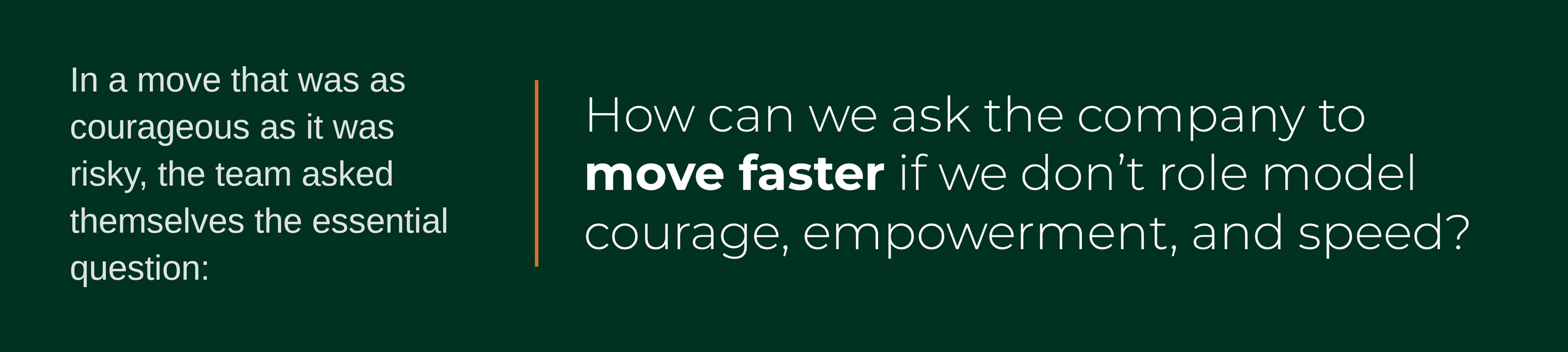
I kicked off the ELT culture working session by reminding them that even the best teams pause during halftime to look back and think ahead. They responded by sharing their own experience working together as an executive team.
One by one, they shared powerful experiences and metaphors that helped them see more clearly the symptoms and root causes of their behavior during team meetings. The discussion revealed more commonalities than differences, and an appreciation that while each team member had a slightly different Why behind their work, they all shared positive intention and a desire to lead as one unified and collaborative team.
Identifying problems
Too much time debating too many decisions without long-term or enterprise ramifications that did not meet the threshold for executive team decision-making.
Not enough discipline in structuring debates and clarifying the process to make and execute decisions.
Then, I asked them to write, individually and then collectively, what they wanted that same survey of the company’s most senior leaders to say about them seven months later. Without hesitation, they landed on two inspiring sentences:
We trust one another to act with ownership, speed, and accountability.
We debate with discipline, balancing bold opportunities with thoughtful risk assessment.
With these two statements in front of us, we began the harder work of making commitments.
The obvious explanation didn't hold up
At the onset, team members named a problematic habit of treating nearly every decision as a high stakes one. In Thinking, Fast and Slow, Daniel Kahneman describes the trap as failing to effectively differentiate between System 1 and 2 thinking. One team member referenced Bezos’ discipline of focusing on just 3 critical decisions each quarter: ones that are complex, enterprise-wide, and have long-term implications. They agreed to be more disciplined about triaging which decisions to delegate. They needed to do a little less, a lot better.
But this commitment was not a magic cure-all solution, and the team was quick to share that even the important System 2 decisions suffered from long delays and churn. So they took a few more minutes to explore what else was getting in the way. The areas they zeroed in on are actually common problem areas among most of my clients:
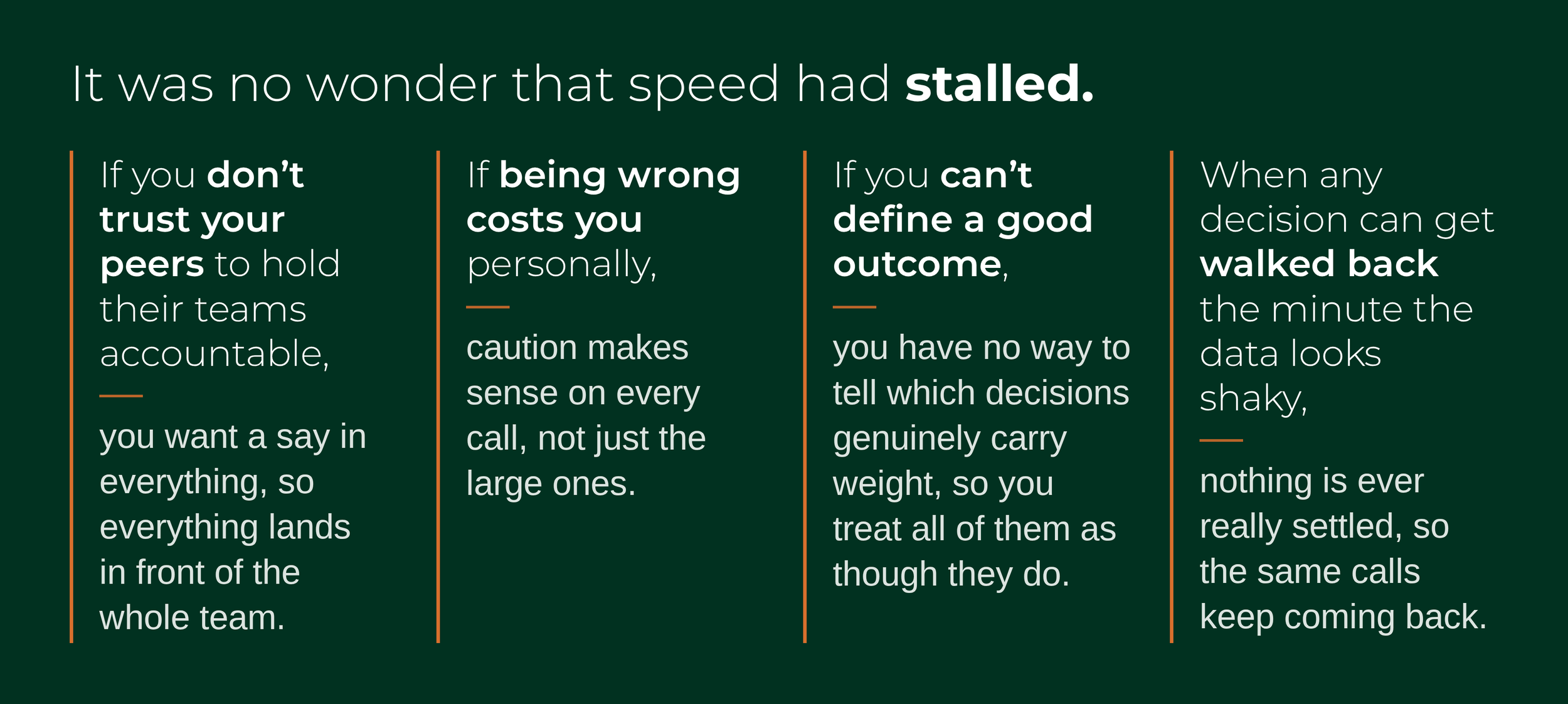
Fear. With growth rates and Free Cash Flow being scrutinized by the board and investors every day, each key customer negotiation, key hire, and strategic investment felt like an existential crisis.
Constraints and desired outcomes, undefined. Nobody could say precisely what success looked like for a given decision, so nobody could tell when they'd reached it.
Debate and commit, in name only. There was a suspicion, proven to be true many times over, that leaders would leave the room with passive and soft commitments that would be walked back the second data suggested the decision might have been the wrong one.
Accountability for results. Whether they believed their peers would hold their teams accountable for delivering on their commitments.
These four symptoms of poor performance had trapped the team and slowed down decision-making. They were some of the sharpest people in their industry, hired and promoted for exactly the instincts that were now slowing them down. When you've spent a career being rewarded for catching the flaw nobody else caught, you don't stop because the room needs a decision instead.
The easy, first step toward making better, faster decisions
At the behest of the CEO, we embarked on two intractable decisions that had been holding the team back. It required a more formal structure and process, introduced in 5 simple steps.
Circle and align on the essential question. Before running headlong into the discussion, we paused to give everyone a chance to ask clarifying questions about the persistent challenge, and revised the problem statement, written as a single sentence starting "How do we...?"
Classify it. We then confirmed that the statement was truly an ELT-level decision that warranted their time and attention, rather than delegation and an informed and well-communicated status update. Sorting doesn't just shrink the ELT’s pile. It makes sure the most important decisions get the handling they need.
Backstory. Next, the team spent a little time as historians, exploring how they arrived at this point. With that context, they could decide what they needed to do to ensure that today’s solution did not become tomorrow’s problem (again).
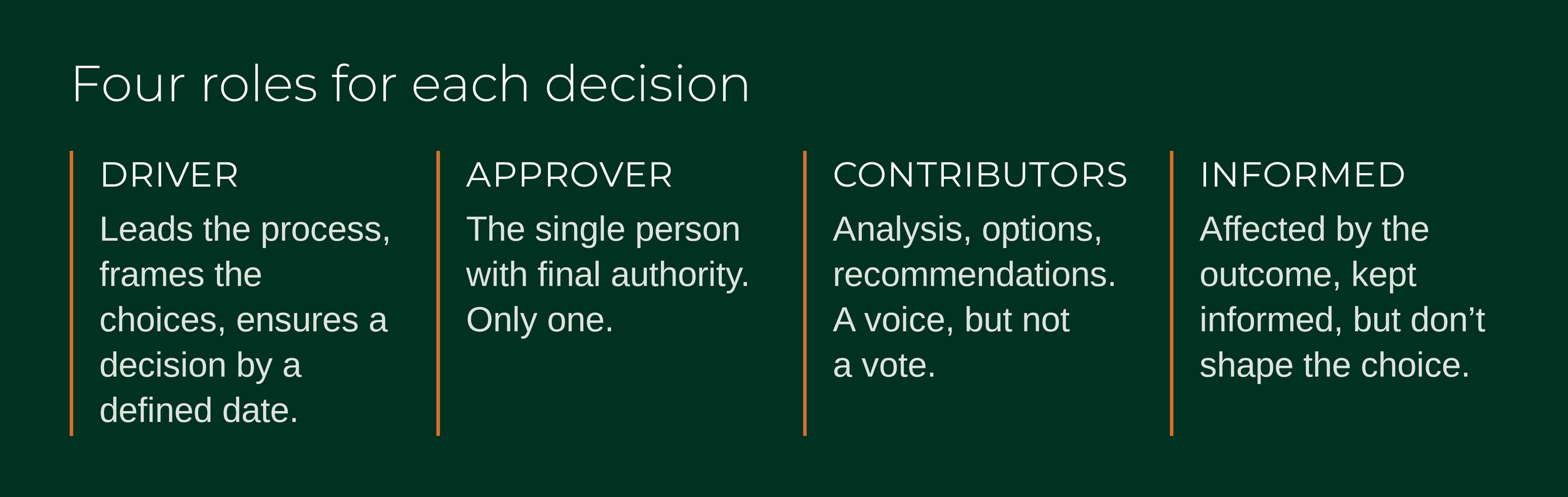
DACI and desired outcomes. This step really resonated with the team. They recognized that the clarity on naming, explicitly four roles for each decision would increase trust. One Driver, one Approver, named Contributors, everyone else Informed, deadline stated up front.
Debate and Commit. The team needed to explore risks, biases, and noise to make a decision that, even if they were not all in 100% agreement, they could and would genuinely support. They needed to leave the meeting with a full-throated endorsement of whomever was the Driver, offering whatever resources and support the team needed. No undermining, second guessing, or passive spectating. System 2 decisions require another level of trust than they had been willing to give one another.
The harder, second step
If the first step was to create better structure and process, the second step was to name low-trust behaviors that cause most decisions to be recycled or postponed.
This team noticed that too many decisions were escalated, re-analyzed, and quietly delayed until someone senior enough would carry the risk — most often the CEO. From below, the symptom presented like a team that couldn't make decisions. From the board’s perspective, they were an ELT that lacked courage and confidence.
So the team named what it would take, and began to embrace it: trust the five-step process, acknowledge the pressures, and trust one another to commit.
What it looked like in practice
None of it works without Debate and Commit, which the team had already named as their gap. Say the objection out loud in the room rather than nodding along, then say just as plainly what you'll do to support the decision anyway. Not afterward in the hallway. There, on the record.
A plan for the future
By the end of the session, the team had hard deadlines and the confidence and tools they needed to meet them. Follow-up, to both audit and update their decision-making process, will be key to sustaining progress. However, the iceberg is moving, and the team is feeling better about adopting new processes, and about taking accountability and trust to the next level to fulfill improvements that could be seen and felt by employees, board members, customers, and investors.
