
Every one of my clients has ambitious growth goals, and most of those goals create a tension between driving incremental growth from their core business (the now) and seismic growth from adjacent or entirely new markets (the future). But this isn’t a trade-off so much as a balancing act. It’s imperative that companies meet the current budget while investing in new products, services, and new clients to drive long-term, sustainable growth. However, there’s an inherent temptation to stretch the team to its limit to maximize short-term growth, with almost no dedicated capacity or time to think about longer term innovation or expansion initiatives.
McKinsey's three horizons model simplifies these time horizons, and reminds teams to commit to managing them differently — in many cases with entirely distinct priorities:
Horizon 1: Today’s core business. This is near-term revenue, used to generate next year’s Annual Operating Plan. The source of this growth is existing or legacy customers, products, or services.
Horizon 3: Opportunities to drive future growth. R&D, pilot programs, or small acquisitions are highly uncertain but are assessed through the lens of viability to drive >10% revenue growth.
Horizon 2: Opportunities that can be scaled quickly through strategic initiatives. Ideally, Horizon 2 revenue should contribute to next year’s growth goals, provided they don’t compete with time and attention to achieve in-year revenue.
The horizons aren't meant to be worked through sequentially. Rather, they have to be managed simultaneously. This is where competing priorities, values, and fear can confuse and frustrate leadership teams without the conviction or systems to manage all three horizons at once.
Symptoms of these tensions surface in feedback like, “we need more accountability,” “there’s no strategic vision,” and “we launch too many initiatives.”
Same metrics, different priorities
In order to shift from either/or thinking, and truly nurture capacity to drive both long- and short-term growth, I work with clients to measure each time horizon by the same metrics, prioritized differently. Doing this right means structuring the team and trade-off decisions to be mindful of these tensions, and to strike the right balance — so that long-term opportunities aren’t starved or consistently put on hold.
In his book, Zone to Win, Geoffrey Moore splits the three horizons into four zones. The Performance and Productivity zones run today’s business (Horizon 1), the Transformation zone scales new bets (Horizon 2), and the Incubation zone develops early ideas (Horizon 3). Here’s how each one is managed:
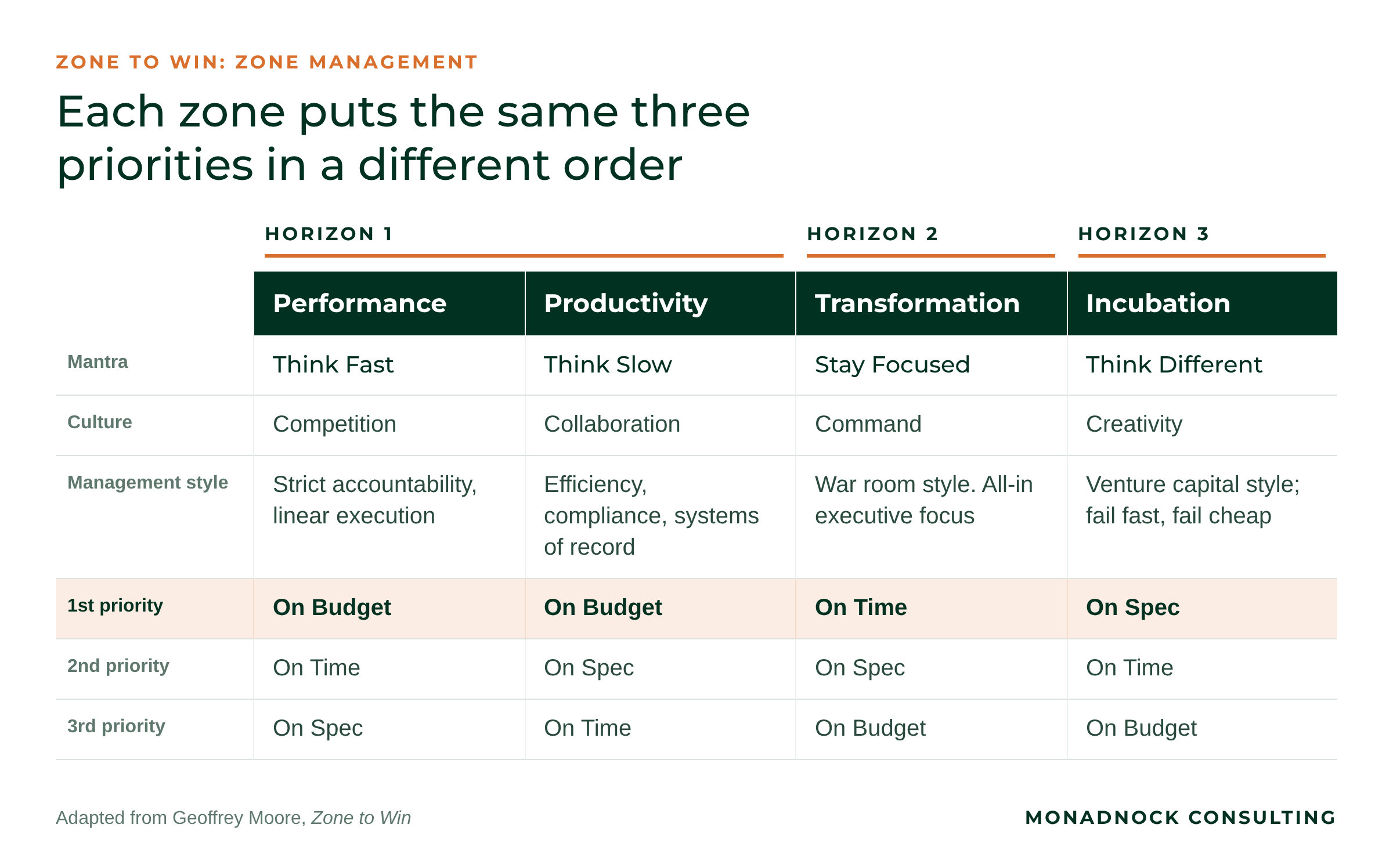
Most leaders say yes to balancing multiple time horizons without fully committing to it. That’s where they fall into one of two traps.
Trap #1: When every new idea dilutes the last
This trap typically starts with a CEO or CRO’s impatience, causing them to push leaders to be more ambitious and bolder. New stretch goals are created, initiatives are launched to support them, and, one by one, each new idea gets diluted by the next.
From the CEO's seat, the pushing makes sense. Without a bold approach, they feel the company will remain perfectly designed to achieve today’s results. But one or two levels deep, people are already tapped out trying to drive near-term growth. One former naval officer in the Medical Corps described this feeling to me as having every app on her desktop open, causing processing time to slow and the entire system (her brain) to crash.
Yet the requests to add, redirect, or change keep coming. Every new priority forces a reprioritization, and every reprioritization kills the last idea to make room for the next one.
For a leader that cares about long-term sustainability, the cost of this way of leading is even more painful. Even the highest performing VPs and mid-level managers develop antibodies to these new initiatives, and begin saying yes to new ideas, only to immediately discard them as unrealistic given what else they have on their plate.
Trap #2: Saying yes without fully committing
The typical executive loves to signal support for long-term, legacy-cementing growth initiatives. But when their inbox begins to fill up with urgent fires to put out, Horizon 3 initiatives with squishier metrics fall by the wayside.
When a leader asks how the new Horizon 3 initiative is going, they might hear “I’m not sure” or “I’m going to work on it after the QBR.”
Skeptical leaders, or those on lower-trust teams, are watching for the first sign of wobble so they can pull back from the brink just in time.
With their calendars already full and nervousness about hitting their own goals, they have limited time for long-term, highly uncertain initiatives that someone else is accountable for.
Over time, the hedging compounds. I was recently working with two leaders inside a global semiconductor company. The CTO was tasked with bringing a new product to market, and he needed buy-in from a business unit president. To his delight, the BU president signaled endorsement and commitment to the idea, but then quickly went hands-off, passively waiting and watching for the CTO’s product push to fizzle out.
The CTO resented the false commitment, and trust eroded. Not surprisingly, subsequent product innovations got the same treatment, further reinforcing their low-trust relationship. Eventually, the CTO quit, leaving the company with a deficit in intellectual capital and behind the competition.
Readers of my last article that covered Debate and Commit will recognize the pattern. It's the same story of trust and accountability, but here it starts with this false surge and slow death of Horizon 3 innovation and growth initiatives.
Recipe for success today, and tomorrow
Assign every C-suite leader to work within one time horizon.
Construct metrics and methods that allow activities and outcomes in each time horizon and zone to thrive in distinct ways.
Artificially constrain executives, limiting the number, frequency, and scope of new “ideas” or “initiatives” that can be launched and mandated at any one time.
Double down on getting to yes, ensuring that any Horizon 3 commitments are genuine, supported by peers. Harvest the lessons from bets that fail.
That's how a team builds the muscle for continual Horizon 3 investment, instead of pretending there's a Horizon 3 while only running its Horizon 1 business.
The next time your team says yes to a new idea, look past the yes. Who is fully in, and who is already watching for the first sign of wobble?
Sources
McKinsey & Company, “Enduring ideas: The three horizons of growth,” December 2009. The framework originated in The Alchemy of Growth (1999) by Mehrdad Baghai, Stephen Coley, and David White.
Geoffrey A. Moore, Zone to Win: Organizing to Compete in an Age of Disruption (2015).
